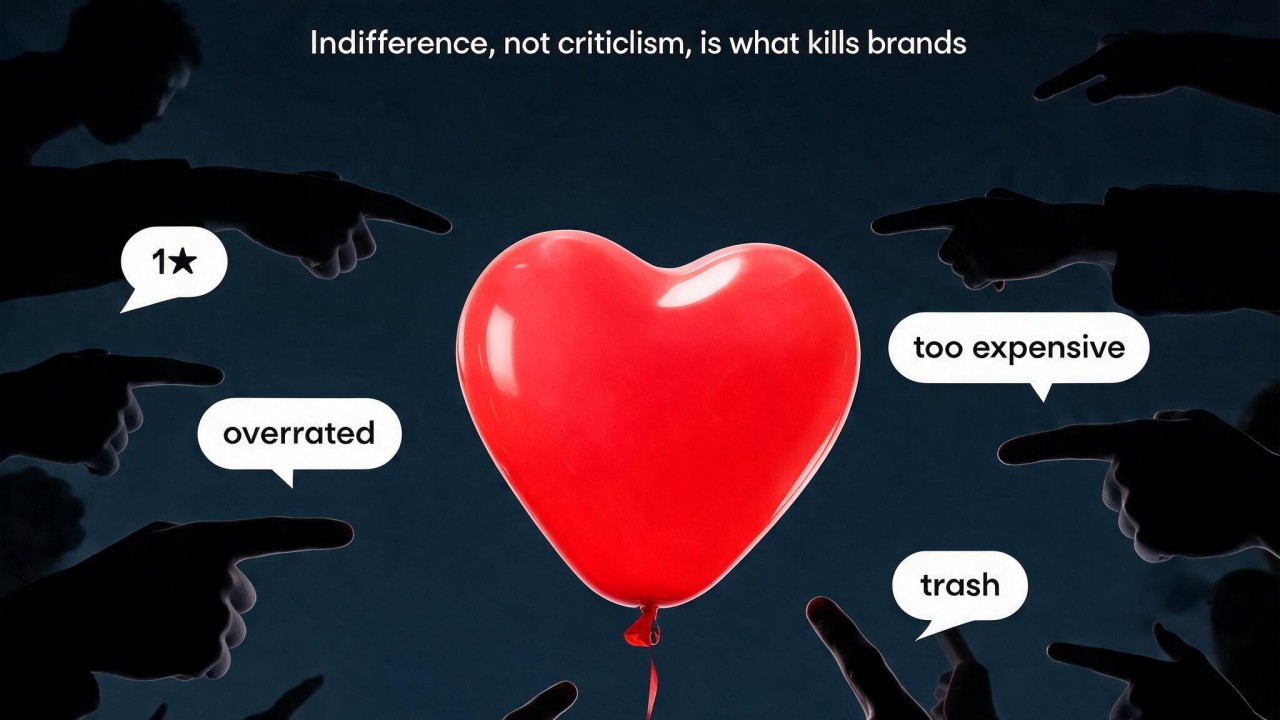
I used to take one-star reviews very personally. I'm not talking about the polite ones, but the sharp, slightly unfair ones that feel like they're aimed at you more than your product. The kind that sits with you longer than it should because it makes you wonder if quitting your 9 to 5 was a good idea in the first place. I would reread them, over-analyse them, and quietly question whether I was getting everything wrong.
After finishing my Masters in Marketing and Brand Management, I started seeing them differently. I still read them, but with a strange sense of calm. Sometimes I even screenshot them, not because I enjoy criticism, but because they represent something most brands never reach. They are proof that something I built made someone feel strongly enough to stop, think, and respond. And in a world where most things are ignored, that matters more than we like to admit.
The real enemy is indifference.
The real problem is not about people not liking what you are building. The real problem is when nobody feels anything at all. That is what we call indifference, and it's your target audience's way of saying "you could literally stop existing and we still wouldn't care."
They do not argue. They do not question. They do not engage. They simply scroll past and forget you ever existed. There is no feedback, no tension, no resistance. Just silence.
And silence is exactly where brands disappear.
We tend to fear criticism because it is loud and uncomfortable, but at least it is a signal. At least it tells you that you showed up in someone's mind. Indifference gives you nothing. No signal, no reaction, no indication that what you are doing even registered.

Have you ever been in that situation where you make your partner or someone you love mad, and they just stay silent? You're literally begging them to say something, because regardless of what they say in that moment, at least it shows that they still care. But then they choose to remain silent and indifferent. We would both agree that that's a far more dangerous place to be.
Nobody writes paragraphs about average.
Nobody writes paragraphs about something that felt average. Nobody takes time out of their day to explain how something was "fine." People only react when something disrupts them, when it challenges what they expected, when it feels too bold or too different or slightly uncomfortable. That reaction, even when negative, is a form of connection, because it at least tells you they feel something.
Emotion — even negative emotion — means you crossed the line from being ignored to being noticed.
And attention is everything in today's world.
Brands that try to avoid criticism often end up designing themselves into irrelevance. They smooth out every edge, soften every opinion, and dilute every message until nothing stands out. It feels safe in the moment, but what they are really doing is making it easier to be ignored.
Now think about the last time you saw a brand say something that made you pause. Not because it was perfectly written, but because it felt honest. Maybe you agreed instantly, maybe you disagreed, but either way, you felt something. You remembered it. You might have even gone back to it later.
That feeling is exactly what your brand might be missing.
Say something clearly, and the right people show up.
When you finally say something clear, something that reflects a real point of view, the response changes. Some people will push back. Some will misunderstand you. Some will decide it is not for them. But at the same time, others will quietly recognise themselves in what you said.
They may not announce it, they may not comment, but they pay attention. They follow more closely and they trust more quickly. Those are the people who stay.
There is also an uncomfortable truth hidden inside criticism. The people who challenge you are often the ones spreading your message further than your supporters. They question you publicly, they quote you, they pull others into the conversation. What feels like resistance is often just visibility in disguise, and you cannot create that kind of reach with silence.
At the same time, some things become clearer when people react strongly to your brand. You start to understand who you are for and not for, and that clarity is very powerful. Hundreds of thousands of global brands willingly pay for this same clarity — it stops you from chasing approval from people who were never going to choose you, and forces you to focus on the people who actually connect with what you are building.

Provocation with integrity, not for the sake of it.
Of course, not all negativity is useful. There is a difference between being disliked because you stand for something and being disliked because you lack integrity, or being insufferable and unreasonable just for the sake of views and engagement. One builds a strong identity. The other builds resentment and erodes trust.
The goal is not to provoke carelessly, but to express something real enough that it naturally creates a divide.
Because that divide is where positioning lives.
And this is the part that most people avoid confronting. If you put something into the world and nobody reacts, nobody questions, nobody pushes back, that does not mean you did a good job. It usually means you were not clear enough, not bold enough, or not distinct enough to be remembered.
Silence is not validation. Silence is absence.
At least criticism tells you that you exist in someone's mind. At least it tells you that you interrupted the scroll, even if only for a moment. Indifference does not even give you that.
So if everything around your brand feels calm, agreeable, and quiet, it might not be a sign that you are doing things right. It might be a sign that you are being overlooked.
And being overlooked is the one thing no brand can afford.
The brands that grow are not the ones that try to be accepted by everyone. They are the ones that accept being rejected by some. They choose clarity over comfort, even when it creates friction. So say something that risks a reaction. Be bold enough to build something that is not for everyone. Stand for something clear enough that it makes the wrong people step away.
The moment people start to feel something, even if it is not always positive, is the moment your brand stops being invisible.
In the long run, being challenged is far more valuable than being ignored.
If your brand feels safe, quiet, and easy to overlook, that's the problem worth fixing. Let's give it a point of view sharp enough to be remembered.
Start a conversation